Commercial Investment Opportunities Near Vizhinjam Port: A 2026 Guide
Table of Contents
- Introduction
- Why Vizhinjam Port Matters for Commercial Real Estate
- Commercial Investment Near Vizhinjam Port: Key Opportunities
- Shops and Retail Spaces
- Office and Business Spaces
- Warehouses and Logistics Properties
- Commercial Buildings
- Logistics-Related Business Properties
- Land for Future Commercial Development
- Hospitality and Service Businesses
- Areas to Watch Around Vizhinjam
- What Makes a Commercial Property Suitable?
- Risks and Due Diligence
- Is 2026 a Good Time to Study Vizhinjam Commercial Property?
- Frequently Asked Questions
- Conclusion
Introduction
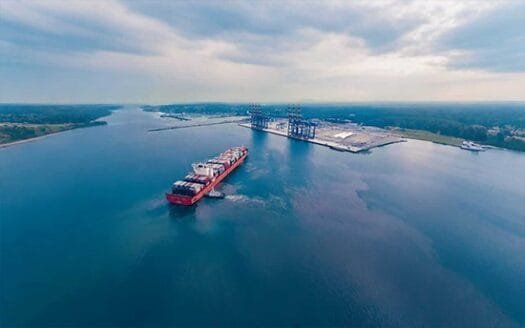
Commercial Investment Near Vizhinjam Port is attracting increasing attention as Vizhinjam develops from a major transshipment facility into a broader port-linked economic ecosystem.
Vizhinjam International Seaport’s Phase I became operational in December 2024 with an annual handling capacity of 1 million TEUs. The next capacity expansion is targeted for completion by December 2028, with planned capacity increasing to 3 million TEUs annually and potential throughput of up to 5.7 million TEUs through automation and operational efficiencies.
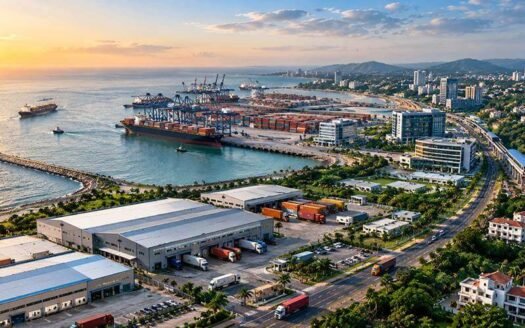
This expansion can create demand not only inside the port but also across supporting sectors such as logistics, warehousing, transportation, retail, offices, hospitality, food services, maintenance and other commercial activities.
For property investors, the important question is not simply whether land is close to the port.
The more important question is:
Can the property support a commercially viable business connected to the growing port ecosystem?
That distinction is important when evaluating any commercial property.
Why Vizhinjam Port Matters for Commercial Real Estate
Vizhinjam is designed primarily for transshipment and gateway container operations, with additional provisions for cruise, liquid bulk and other port-related activities.
The official port development plans also identify a much broader ecosystem, including multimodal logistics parks, inland container depots, container freight stations, cold-chain facilities, truck terminals, fuelling stations and other maritime services.
This creates several potential commercial property requirements.
Businesses may need:
- Warehouses
- Distribution centres
- Office spaces
- Shops
- Service centres
- Truck and vehicle facilities
- Cold-storage facilities
- Commercial buildings
- Staff accommodation
- Hospitality properties
- Food and retail outlets
- Industrial and processing spaces
The official Vizhinjam business-development plan also identifies port-led industrialisation across approximately 3,500 acres in phases and states that 230 acres are currently being acquired for the first phase of the industrial ecosystem.
This makes the port area worth watching from a commercial real estate perspective.
Commercial Investment Near Vizhinjam Port: Key Opportunities
There is no single type of property that automatically benefits from port development.
Different businesses require different locations, building specifications, road access and land sizes.
The following are some of the major commercial property categories investors can study.
1. Shops and Retail Spaces
Growing commercial activity can create demand for everyday retail and service businesses.
Potential businesses include:
- Restaurants and cafés
- Supermarkets
- Hardware stores
- Automobile-related businesses
- Mobile and electronics shops
- Pharmacy and healthcare services
- Banks and financial services
- Courier and parcel services
- Travel-related businesses
- Professional service offices
A small commercial property on a suitable road with good visibility can sometimes be more practical than a large property in a poorly connected location.
For retail investment, visibility, parking, pedestrian movement and road accessibility can be more important than simply measuring distance from the port.
2. Office and Business Spaces
Port activity involves many businesses beyond cargo handling.
Shipping agencies, logistics companies, customs-related services, freight operators, transport companies, consultants, financial service providers and other businesses may require office space.
This creates a potential market for:
- Small office buildings
- Commercial floors
- Serviced offices
- Business centres
- Professional offices
- Logistics company offices
- Shared office spaces
Investors considering office properties should examine connectivity, parking, building approvals, power supply, internet connectivity and the ability to divide the property into multiple rentable units.
3. Warehouses and Storage Properties
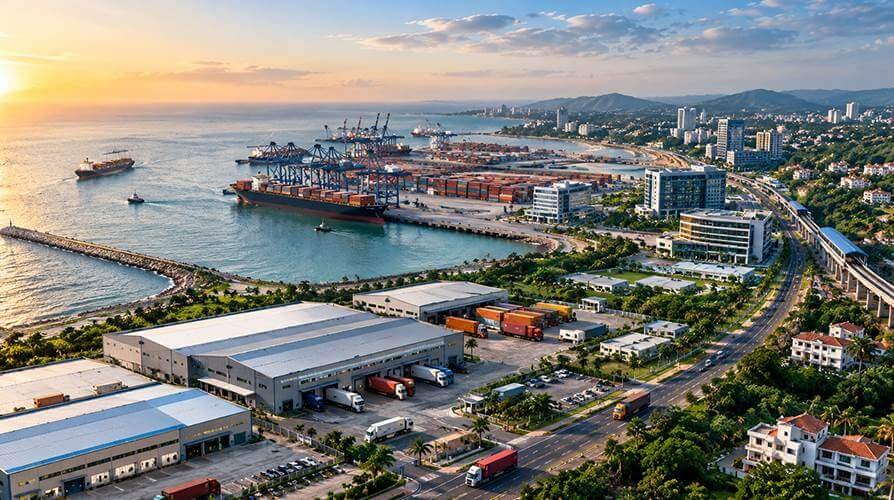
Warehousing is one of the most important commercial opportunities associated with a growing logistics ecosystem.
The official Vizhinjam development plans specifically identify multimodal logistics parks, inland container depots, free-trade warehousing zones, container freight stations and specialised cold-chain infrastructure.
Private commercial properties can potentially serve businesses requiring:
- General storage
- Distribution
- Equipment storage
- Food storage
- Cold storage
- Packaging
- Inventory management
- Regional distribution
However, a warehouse property should be evaluated differently from a normal commercial building.
Truck access, loading areas, floor strength, ceiling height, plot configuration, turning radius, power availability and road width can significantly affect its usefulness.
4. Commercial Buildings
Existing or newly constructed commercial buildings can provide multiple revenue possibilities.
For example, a building could potentially accommodate:
- Ground-floor retail
- First-floor offices
- Service businesses
- Restaurants
- Clinics
- Training centres
- Logistics offices
A well-designed multi-purpose commercial building may provide greater flexibility than a property designed for only one business.
Investors should also examine the permitted use of the building before assuming that every commercial activity can operate from the property.
5. Logistics-Related Business Properties
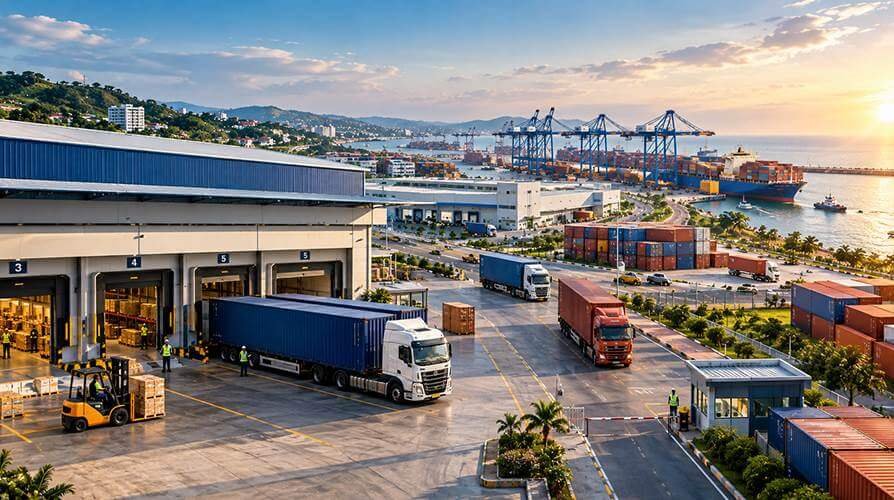
The port ecosystem can create opportunities beyond traditional warehouses.
Potential supporting businesses include:
- Transport offices
- Truck parking facilities
- Container-related services
- Packaging businesses
- Equipment storage
- Freight-forwarding offices
- Vehicle maintenance
- Commercial yards
- Distribution facilities
- Cold-chain operations
The official Vizhinjam business plan identifies maritime and logistics services including bunkering, ship repairs, mooring services, ship chandelling, stevedoring and related agencies.
This indicates that the wider commercial ecosystem could extend well beyond the port’s physical boundary.
6. Land for Future Commercial Development
Large land parcels may attract interest from businesses requiring substantial development areas.
Potential uses can include:
- Warehouses
- Logistics facilities
- Industrial buildings
- Commercial complexes
- Vehicle yards
- Distribution centres
- Business parks
However, land should not be purchased solely because it is described as “near Vizhinjam Port.”
Before purchasing, investors should verify:
- Current zoning
- Permitted land use
- Road access
- Width and ownership of access roads
- Development restrictions
- Environmental restrictions
- Coastal regulations where applicable
- Acquisition proposals
- Utility availability
- Flood and drainage conditions
- Clear title and encumbrances
A cheaper parcel with poor access or unsuitable zoning may be less commercially useful than a smaller parcel with excellent connectivity and appropriate permissions.
7. Hospitality and Service Businesses
Port development can also create opportunities for businesses serving workers, visitors, executives, contractors, transport operators and other professionals.
Potential commercial formats include:
- Hotels
- Budget accommodation
- Serviced apartments
- Restaurants
- Cafés
- Business centres
- Travel services
- Vehicle rental
- Meeting and conference facilities
The opportunity depends on actual demand, competition and location.
Hospitality investors should therefore study occupancy potential, accessibility, parking, tourism demand and nearby commercial development rather than relying only on port-related expectations.
Areas to Watch Around Vizhinjam
Investors should think in terms of commercial corridors and connectivity, rather than drawing an arbitrary radius around the port.
Vizhinjam itself is the immediate port location, while surrounding areas connected to major roads and planned infrastructure may also become relevant to different types of commercial activity.
Potential areas to study include:
- Vizhinjam
- Venganoor
- Kovalam
- Balaramapuram
- Poovar
- Neyyattinkara
- Pallichal
- Kottukal
- Nearby NH-66 and major connecting corridors
The suitability of each location will depend on the intended business.
For example, a retail shop may benefit from local population and visibility, while a warehouse may require better heavy-vehicle access and proximity to logistics routes.
Kerala’s 2026 development planning documents also identify port-linked infrastructure such as the Vizhinjam railway line, the proposed Vizhinjam–Navayikulam outer ring road and development corridor, and the Vizhinjam–Kollam–Punalur industrial and economic growth triangle.
These projects should be treated as infrastructure developments to monitor rather than as guaranteed completed facilities.
What Makes a Commercial Property Suitable?
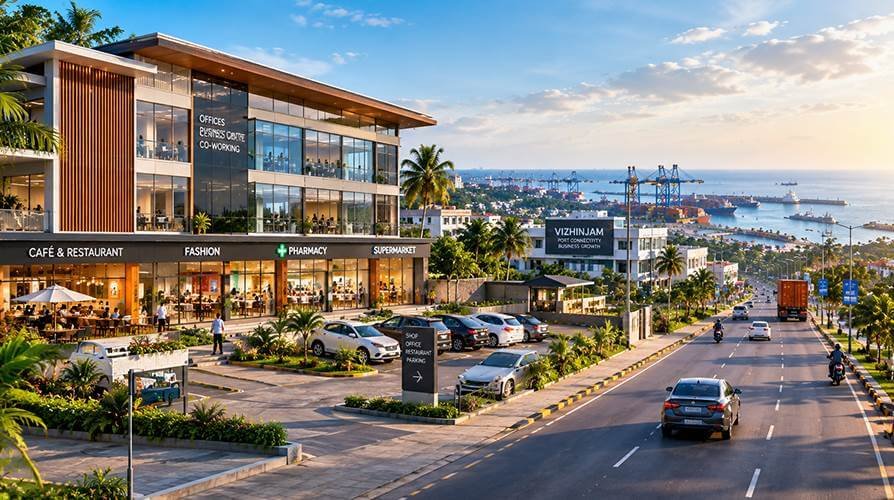
When evaluating commercial investment near Vizhinjam Port, consider the following factors.
Location
Distance matters, but practical connectivity can matter more.
Check how easily customers, employees, trucks and suppliers can reach the property.
Road Access
A property with good road frontage and suitable access can have an advantage for many commercial uses.
For logistics properties, road width and vehicle movement are particularly important.
Visibility
Retail and service businesses generally benefit from good visibility.
Properties hidden inside narrow roads may have limited suitability for customer-facing businesses.
Parking
Parking can influence the rental and business potential of commercial properties.
Consider both customer parking and loading requirements.
Building Specifications
For warehouses and industrial uses, examine floor loading, ceiling height, electrical capacity, loading areas and structural suitability.
Development Potential
For land purchases, investigate what can legally be constructed and what commercial uses are permitted.
Rental Demand
Do not assume that port development automatically means high rental demand.
Study existing businesses, competing properties, asking rents, occupancy and the actual requirements of potential tenants.
Risks and Due Diligence
Commercial investment carries risks, even in locations experiencing major infrastructure development.
One major risk is paying a premium before the expected commercial demand actually materialises.
Land prices can also rise in anticipation of infrastructure projects, reducing the potential return for new buyers.
Another important issue is land acquisition.
Government agencies have been working on land acquisition and industrial/logistics infrastructure associated with Vizhinjam. Investors should therefore check whether a property is affected by any proposed road, railway, logistics, industrial or other infrastructure project before completing a purchase.
Before investing, consider obtaining and verifying:
- Title deed
- Encumbrance Certificate
- Previous title documents
- Land tax records
- Survey sketch
- Possession certificate where applicable
- Zoning and land-use information
- Building permits
- Approved plans
- Road access documents
- Utility availability
- Acquisition notifications
- Environmental and coastal restrictions where applicable
Professional legal and technical due diligence is particularly important for large commercial land purchases.
Is 2026 a Good Time to Study Vizhinjam Commercial Property?
2026 is an important period to monitor Vizhinjam’s commercial ecosystem because the port is already operational while additional capacity and supporting infrastructure are being developed.
The official port development programme identifies logistics, warehousing, industrialisation and maritime services as important parts of the wider ecosystem.
The port’s capacity augmentation programme is targeted for completion in December 2028.
At the same time, commercial investors should avoid treating infrastructure development as a guarantee of property appreciation.
A better approach is to identify properties where there is a clear business case.
For example:
Good commercial analysis = Location + Access + Permitted Use + Business Demand + Property Cost + Rental/Operating Potential + Risk Assessment
This approach is more useful than simply asking how close a property is to Vizhinjam Port.
Frequently Asked Questions
Is Vizhinjam Port creating commercial investment opportunities?
Vizhinjam’s development is creating potential opportunities across logistics, warehousing, maritime services, industrial activity, retail, offices and other supporting businesses. The suitability of a particular property depends on its location, permitted use and commercial demand.
What type of commercial property can benefit from Vizhinjam Port?
Potential categories include warehouses, logistics facilities, commercial buildings, offices, shops, restaurants, service businesses, industrial properties and land suitable for commercial development.
Is land near Vizhinjam Port a guaranteed investment?
No. Proximity to the port does not guarantee appreciation or rental income. Investors should evaluate title, zoning, access, development restrictions, acquisition proposals, market demand and purchase price.
Are warehouses a potential opportunity near Vizhinjam?
Yes. Warehousing and logistics are specifically identified within the port’s wider industrial ecosystem. However, warehouse investors should pay particular attention to road access, truck movement, loading facilities, plot size and building specifications.
What should I check before buying commercial land near Vizhinjam?
Check title, encumbrances, zoning, land use, road access, survey records, development permissions, utilities, acquisition proposals and applicable environmental or coastal regulations.
Can small investors participate in the Vizhinjam commercial growth story?
Potentially, yes. Commercial opportunities are not limited to large logistics parks. Depending on location and demand, smaller properties such as shops, offices, restaurants and service-oriented commercial spaces may also have a role in the developing ecosystem.
Conclusion
Commercial Investment Near Vizhinjam Port is a developing opportunity that extends beyond buying land close to the port.
The larger opportunity is the ecosystem being created around port operations.
Warehouses, logistics facilities, commercial buildings, offices, shops, hospitality properties, service businesses and suitable development land could all play a role as the Vizhinjam ecosystem expands.
For investors, the key is to focus on business fundamentals rather than speculation.
A commercial property with good access, appropriate zoning, strong visibility, practical infrastructure and genuine tenant or business demand can be more valuable than a property that is simply marketed as being “near Vizhinjam Port.”
As Vizhinjam’s capacity expansion and port-linked infrastructure continue, commercial property investors should monitor the area carefully, conduct proper due diligence and evaluate each property based on its actual business potential.
- Vizhinjam International Seaport – Project Details — official project information, capacity and connectivity.
- Vizhinjam International Seaport – Business Opportunities — particularly useful for the logistics, warehousing and industrial sections.
- Press Information Bureau – Vizhinjam Port Capacity Expansion — supports the 2024 operational date and December 2028 expansion target.
- Vizhinjam International Seaport – Technical Reports — useful for readers wanting detailed railway and master-plan documents.